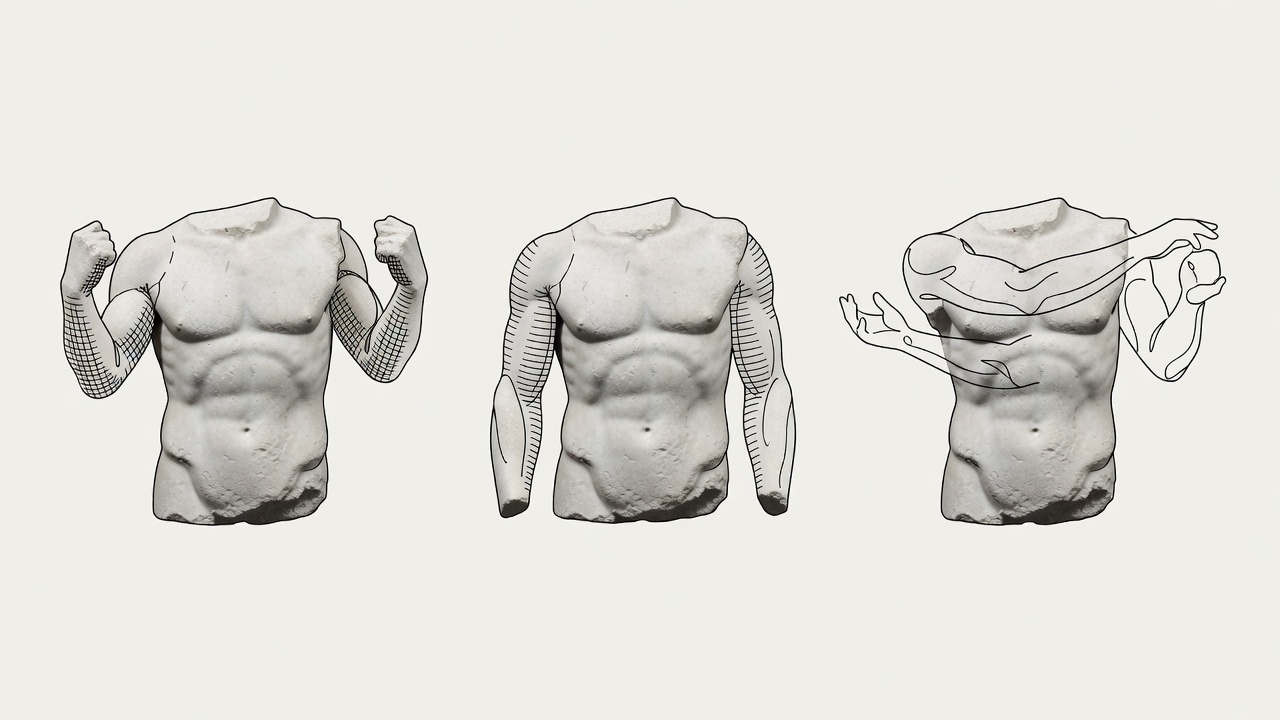
Choose a method for the evidence available
Digital reconstruction ranges from joining well-matched fragments to generating an entirely speculative missing figure. These activities should not share an undifferentiated label of “restoration.” Describe the operation precisely: alignment, symmetry-based inference, reference-guided modeling or generative proposal. The method determines what kind of claim the result can reasonably support, and what information must accompany its display.
Begin with the least interpretive operation that answers the research question. If the task is to test a join, a carefully aligned fragment pair may be sufficient. If the task is to explain possible poses in an exhibition, several simplified alternatives may communicate more responsibly than one highly detailed completion. Visual richness is not always the most informative outcome.
Fragment fitting and geometric constraints
Matching fracture geometry can provide strong constraints, particularly when material continuity and physical examination support the relationship. Automated alignment may help search possible placements, but a low numerical mismatch does not by itself prove a historical join. Similar surfaces, erosion, incomplete scans and algorithmic assumptions can produce misleading candidates. Keep the residual map and the rejected placements available for review.
Do not distort surviving geometry merely to improve a fit without recording that action. If a hypothesis requires deformation, explain whether this reflects a proposed physical history, a measurement limitation or an artistic convenience. A clean rendered seam can conceal substantial adjustments. Compare the transformed result with the original capture so that reviewers can inspect what changed.
Symmetry is an assumption, not a discovery
Mirroring a surviving ear, hand or architectural ornament can produce a useful starting point. It can also erase intentional asymmetry, pose-related differences or workshop variation. Establish a plausible symmetry plane and test its relationship to surviving landmarks. Label mirrored regions as inferred even when the source geometry is measured elsewhere on the same object.
Reference-based modeling has similar limits. A related statue, a cast or a printed drawing may constrain a missing part, but differences in scale, viewpoint and chronology matter. Record which features are borrowed and why. A model assembled from several references should not be presented as though every region came from an object-specific historical record.
What AI contributes—and what it cannot establish
AI systems may assist with segmentation, correspondence, denoising or proposing missing shapes. Their suitability depends on the task, training data, implementation and validation. A model trained on complete objects can favor familiar forms over historically unusual ones. It may normalize damage, suppress irregular carving or generate persuasive details unsupported by the surviving sculpture.
Image generation is especially easy to overinterpret. A convincing two-dimensional view may not define a coherent three-dimensional surface. Different generated views can disagree about depth, attachments or ornament. Converting such images into a mesh does not transform their content into evidence. Treat the result as a proposal and compare it against independent constraints rather than only against its own rendered appearance.
Record the tool, model identifier where available, version, inputs, relevant settings and manual edits. If a commercial service does not expose a seed or underlying model, record that limitation. Do not upload restricted collection data without permission. Review service terms for confidentiality, retention and training use before submitting object images or unpublished research.
Make uncertainty regional and explainable
A single confidence score for an entire sculpture obscures meaningful differences. The surviving torso may be well measured, the neck position constrained by a fracture and the head entirely speculative. Attach evidence statements to regions and distinguish measurement quality from interpretive support. “High confidence” should never substitute for an explanation of the source and reasoning behind a claim.
Use patterns, text labels and independently switchable layers so the distinction survives grayscale reproduction and different viewing conditions. If several completions satisfy the available constraints, publish them together. Explain what evidence might discriminate between them. Do not assign percentages unless a defined, defensible method supports those numbers; an AI system’s internal score is not automatically historical probability.
Review the proposal before publishing it
Ask a reviewer to examine the object without first seeing the completed render. This can reduce the anchoring effect of a memorable generated image. Then compare the proposal against the recorded constraints, including contradictory evidence. Capture disagreements rather than smoothing them into a falsely unanimous conclusion. A declined proposal can be useful when its rejection explains an important limitation.
Finally, distinguish digital interpretation from fabrication or physical intervention. A proposal suitable for discussion does not authorize a replacement part, a mount change or treatment of the original. Those decisions require their own professional assessment, permissions and documentation.